What is Democracy?
The first step to creating a democracy has to involve figuring out how to get others show you what it is.

If you like democracy, and want to live in one, then It’s very important to figure out what democracy actually is. Does anyone know?
Actually, I’ve got the order the wrong way around, so I’ll start again.
If you think that
people are the best judges of their own interest, and
people should have an equal say in decisions that affect them
then you should be able to figure out whether a political system is democratic or not. You should also be able to figure out whether your actions are building a democracy or not.
Consider the two conditions I just stated, which I’ve borrowed from a political science textbook. Informally stated, they were the necessary and sufficient conditions of liberal democracy.1
Condition (1) Is violated by the existence of public relations, managerialism, technocratic institutions, and neofascism. Observing it’s violation is like breathing oxygen.
Condition (2) actually implies that questions such as “is New Zealand a democracy?” are incorrect. ( I’ll ask it anyway in this article). The decisions made by the Chinese or American state are life and death to me, as well as most of the worlds population. I’m talking about their impact on the biosphere. If we have no role in affecting the Whitehouse or CCP’s decisions, then that’s a strong point against democracy.2
It follows that liberal democracy has never existed. One could point out that democracy exists on a spectrum rather than in binaries. That’s a reasonable take, and it’s an additional justification for why saying that “we live in a democracy” is untenable.
Because condition (1) is violated so often, it can be difficult to see how. Even a natural born anarchist like me struggles to see it. Which leads me to the example I’ll use to demonstrate this.
Quite a few people on the liberal, but also some left/radical end of the political spectrum are promoting the idea of deliberative democracy.
Previously I’ve expressed skepticism to the proposals and strategy, and wrote an article critiquing deliberative democracy. I found evidence of deliberation, but no evidence of democracy. Given my standards, that’s not very problematic. But I also found little reason to think it was a constructive attempt to build democracy.
I was also careful to say that:
This will not be a general critique of deliberative democracy per say, but rather two specific presentations of it in New Zealand.
This was because I had not explored it’s implementation outside of New Zealand. Now that I’ve done that, this article will update my views.
Recap
To give a recap from last time, I compared and contrasted the approach of proponents of deliberative democracy in New Zealand with the approach of Roger Hallam. Contrasting their approaches, they were diametrically opposed in every single way.
My critique identified four issues with the approach. Reading from a UN handbook which tells advocates what deliberative democracy is, they summarize my analysis in a single page.
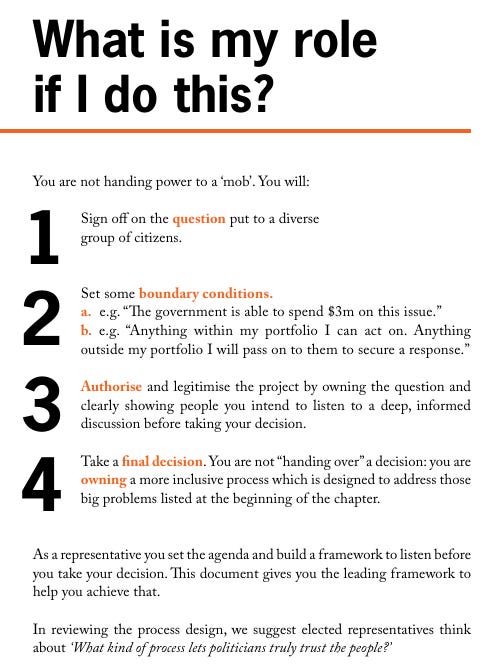
Those were the exact four issues which I identified, which is kind of uncanny. So, basically they spell it out here. And indeed I agree that this approach fails to hand power to the mob.
Here’s a point by point explanation of why:
Going to people and telling them what the questions are prevents them from having any agency in the first place, thus leading to (2), which is setting boundary conditions on policy debate.
Setting the boundary conditions of what can be discussed contains a tacit assumption that people shouldn’t be free to have a say on anything outside of that boundary, whatever it is.
In reality, you have already shown that you have no intention in listening to what people have to say, by creating the boundary conditions for them. The interior of the boundary is where you will listen to them. The exterior of the boundary is where you wont. That’s a problem, because the exterior of the boundary is the only time that it matters.
As the guide says, “you are not handing over a decision.” What this means is that the proposals which are selected from within the boundary conditions will be rejected if the people make the wrong ones. Yet again, there’s an assumption that people are not the best judges of their own interests. So the “recommendation” indicates that you can retract the policies if the mob (or jury, in this case) asks for the wrong ones.
Here’s a point by point explanation of why doing the exact opposite is how democracy is built.
The public come together, and organically raise the questions. Going to people and asking them what the problems and solutions are is one way of doing that. This implies they will have some agency.
Since the public has gained agency over what questions to ask, what the problems are, and what the solutions might be, then the only boundary conditions to the debate are ones set by a lack of imagination.
It follows from (2) that since there are no boundary conditions, the mob will discuss any policy proposals that are within their imagination.
To retain any agency at all, policy proposals are to be implemented with a binding mandate. There are no recommendations of policies, because the use of the word “recommendation” is not applicable if the mandates are binding.
It appears to be the case that every single assembly and experiment in deliberative democracy out of hundreds in the world, rejects the binding mandate option in favour of recommendations. You might try to disprove that statement with a counterexample.
Before discussing examples, I want to elaborate on point (1). There can and often is value in suggesting solutions to people. People complain that I do not, (even though I do).
Sometimes it’s inappropriate to do so, however. And I’m no exception to frequently making that mistake. Roger Hallam has said that he made it early on as well. In the previous article, I quoted Roger Hallam on this:
The first step isn’t preaching. It’s listening — not as a moral posture, but as a design principle.
If you knock doors saying, “Hi, I’m Roger, I’m a socialist, here are our policies, join us, vote for us,” you trigger resistance. Even if you’re right. Even if your policies are good. That’s not the point.
The point is human nature: people become open and motivated when they get to speak. When they talk about their lives, they warm to you. They feel engaged. They feel respected. And then they’ll do a small next step — a meeting, a petition, a chat — because it feels like their choice.
Yeah. Though I’m not sure what “human nature” means here. So I’ll add my own take.
Any oppressive system wants to make its domination over others feel natural, as if no other world is possible. It’s why neoclassical economics teaches people about hard “trade-offs”. It’s probably why the NewDemocracy document I linked above also emphasises hard “trade-offs” as good agenda setting questions, rather than just saying that the billionaires can pay for it all.3
Given this understanding of power, It’s easy to understand why solutions are rarely suggested from the political class. Or are they?
There’s a concept called “reformist reforms”, (contrasting with “non-reformist reforms”). It comes from André Gorz — I haven’t read his work. In any case, reformist reforms are solutions that subordinate themselves to what’s possible within the existing system’s acceptable boundary conditions. Which is neoliberalism. Non-reformist reforms are those which are pushed while challenging the boundary conditions.
The existence of reformist reforms makes it unsurprising that going around suggesting solutions to people who have been attacked over a forty year neoliberal period will respond aggressively towards them, even if those solutions marginally improve their lives. Though many are not be able to articulate how they are being attacked, their instincts tell them that they are.
Thus on the occasion when I’ve suggested solutions to people, I think it’s perfectly reasonable for people to attack me for doing so. That’s happened quite a few times, and I understand why. It’s more prevalent on the internet, if I’m being honest.
So there’s a fine line to how you should suggest solutions to people, and when it’s appropriate to do so. I’m still figuring out where that line is.
Examples of Boundary Conditions
I decided to read about the really existing functioning of citizen climate assemblies outside of New Zealand. Including in Denmark, and in France. These assemblies have a lot in common with the above description of deliberative democracy.
In terms of design, much attention is directed to the procedural aspects of mini-publics: forums in which (quasi)randomly selected citizens deliberate on a specific issue, exchange reasons, weigh diverse perspectives, and consult experts or advocates in order to formulate recommendations
Briefly looking through a list of hundreds of citizen assemblies, they resemble the pattern that’s described in the NewDemocracy report. There is one difference, however. Some of them allow more agency for creating the boundary conditions of policy debate.
Denmark’s Boundary Conditions
According to this study on Denmark’s system
members were told to adhere to the principles laid down in the Danish Climate Act and that the assembly’s recommendations must take into account “sustainable business development and Danish competitiveness, sound public finances and employment, and that Danish business must be developed rather than diminished”
The boundary conditions are that the policies are fine so long as they do not challenge neoliberalism. Before neoliberalism, in NZ at least, there were no limits on public debt. What “sound public finances” means is a debt limit and in Europe’s case, a deficit limit as well. The interior of the boundary is tinkering around the neoliberal system, the exterior is challenging neoliberalism and beyond.
There’s a point to be made here about local citizen assemblies, and the limits on them. Yes, you have to start locally. But you have to recognize that it’s physically impossible to move beyond the neoliberal order while at the local level. The boundary conditions of neoliberalism are largely set at the national and international levels. Constraints on public finance is one example of that.
The recommendations couldn’t be rejected because they were not even listened to.
In the late spring of 2021, the Ministry of Climate, Energy and Utilities published the assembly’s first 117 official policy recommendations. The recommendations were, in a number of areas, notably more ambitious than the political line of the government. …
The second round of the DCCA, which began in the fall of 2021, painted a similar picture. This time, the opening and closing weekend assemblies were carried out in person, while evening meetings remained on Zoom. In May 2022, when the assembly presented their second round of 73 recommendations to parliament, history repeated itself: Only a handful of politicians attended the meeting, and the climate minister Dan Jørgensen left half-way through.
France
France fares better than Denmark. Macron initially said he was going to implement all but three recommendations. 146/149 of them. However, it appears that France implemented a much smaller number of them.
Despite the widespread perception of the CCC having had a limited impact, our analysis finds that the track record on the adoption of the recommendation of the Convention is more positive than it is usually given credit for. Most of the ideas proposed by the Convention have found their way in some form into relevant laws, policies, and decrees. Over 70 percent of the recommendations have been followed-up by government, either in full or in a modified form. Twenty percent have been fully implemented or even reinforced; 51 percent have been implemented partially of modified.
The researchers argue that France’s assembly had gained some degree of agency in determining the questions and boundary conditions.
We have evidence that the Convention itself generated recommendations that were not consistently articulated within the established political debates about climate governance. Not only did the CCC generate novel recommendations in that sense, but a significant proportion of them made it into law or policy. The CCC had an agenda-setting role.
The CCC should be taken as an example of a positive shift along the democracy spectrum. But it should also show you how much work it will take to overcome neoliberalism.
Belgium
Didn’t really bother too much with this one. It has a strange and complicated setup. Boundary conditions are set through sortition. However, the agency is still lost in the end.
However, there is a big limitation: the outcomes of these assemblies are not legally binding but mere recommendations, as as been explained above. The Belgian constitution grants all power to the the parliament, meaning that unless the constitution is changed and adapted to ensure a more citizen-led deliberative democracy, only non-binding recommendations can be issued.
Wellington
Let’s take my own city. In this case the approach hands over some agency to the public, by letting them set the boundary conditions.
people were asked to rank Council priorities across five categories. … Many of the top-ranked items reflected existing Council priorities including improving infrastructure and resilience, climate action and affordable housing.
But the agency is lost when proposals are to be considered, without binding mandate.
The sessions will be facilitated to ensure all perspectives are heard and a collective view can be developed. The Assembly will then present their findings to the Mayor and Councillors, who will consider them when making decisions about the 2024-34 Long-term Plan.
After much consideration, the Council decided to reject them.
A Little History
In the 1950s there was “participatory democracy” promotion coming out of management science, from the human relations school.4 One criticism was that it lacked democracy. In the 1920’s, there was “industrial democracy” promotion coming from John Leitch. The main criticism was that it lacked democracy.
Yesterday I read an article on how management operates in universities. The tactic is to:
show up to “stakeholder” meetings, make faculty feel heard, but never actually listen, because faculty had little formal power. Farley was following the manual to the letter.
What all of these approaches had in common, is that the boundary conditions were crafted by the ones that had all the power. Strikingly, John Leitch said industrial democracy would work like representative democracy. And how does that work? One of the major ways that elections are rigged in the neoliberal system—and this isn’t just a neoliberal feature — is that the cultural institutions set the boundary conditions on how elections are discussed. And who owns the cultural institutions? The rich. So the boundary conditions will be set in accordance to their interests.
It’s often said that the system we had was democratic before neoliberalism. In my case, I read about anarcho syndicalism when I was young, so it’s easy for me to see that this is not true. Labour was not elected on a neoliberal mandate in 1984. So neoliberalism wasn’t even a recommendation. And if the system was democratic, the public would have been able to get rid of the neoliberal faction after the fact that they were elected.
That’s how a delegation system works, which was a property of anarcho-syndicalism. In other words, it’s a binding mandate. But additionally, there’s recall power with feedback loops. The current electoral system doesn’t even rise to the level of recommendation. If people were told what they are voting for, it would be a big improvement, but it still wouldn’t be democratic. Because politicians would still be able to reject the recommendations.
Discussion
The climate citizen’s assemblies appear to involve more agency in the construction of boundary conditions than what’s coming out of NGOs. That’s likely due to the fact that a lot of these citizen assemblies were a reaction to the pressure bought on by Extinction Rebellion, Friday for Futures and the Yellow Vests.
Still, all limit themselves to recommendations. A recent article in the ecological economics journal spells out a possible solution here.
The scope for expanding the use of deliberative democracy and sortition seems vast, especially in light of the massive political corruption and cost of the current system of representation. For example, the United States spent an estimated $18 billion on the extremely polarizing 2020 national and state elections and $16 billion on the 2024 elections.
Imagine for a moment if this had been done using sortition. The President and Vice President would be selected at random from a large pool of qualified candidates. This pool could consist of all members of Congress and State governors, all of whom would have been selected by the same process. This would spell the end of political parties, lobbyists, political campaigns, and attempts to buy influence. It would be largely free from the distortions of unequal political power and would better represent true democratic representation.
Of course, the current political parties are totally locked-in to the current system and would never agree to such a plan, even in the face of the obvious dysfunctionality of the current system to make political decisions that are for the common good.
So replacing the whole electoral system is one way of going about it. I suspect this would increase democracy by quite a margin if every nation state did that.
It is, of course, a completely reasonable and common criticism to say that a hundred people randomly selected to run society is still highly limited in terms of participation and democracy. But the solution to that would be to widen the participation. How does is that expansion achieved though? Majority participation is achieved precisely when the majority of the public decide to participate. Since no one’s going to hand power over to them.
The lesson I want to drive home is that the first step to creating a democracy has to involve figuring out how to get others show you what it is.
p. 17 of Mulgan, R. (2013). Politics in New Zealand. Auckland University Press.
Following condition (2) and using good sense leads to many conclusions that seem unnatural.
on p. 82, for example.
As discussed in Carey, A. (1997). Taking the risk out of democracy: Corporate propaganda versus freedom and liberty. University of Illinois Press and Fones-Wolf, E. A. (1994). Selling free enterprise: The business assault on labor and liberalism, 1945-60 (Vol. 1). University of Illinois Press.
A little correction I want to make here, though i’m sure people can see how to correct me.
Participatory democracy and Industrial democracy have had different interpretations. Some authentic, and some were co-opted terms for the purpose of union busting and avoidance.
Industrial democracy had roughly three interpretations. The AFL, the IWW, and John D Rockefeller’s version.
Participatory democracy has had anarchist interpretations and it’s had the human resources interpretation.
Good.
Also, I think “2. people should have an equal say in decisions that affect them” is only a third of it. What we also need is time. We need the time not only to have our say, but have it contemplated, discussed, and have the time to listen to other peoples as well. Under the Rat Race that exists largely because of “capitalism” and greed and envy, people do not have the time.
I have seen (serious) people comment that they would rather not have democracy because they do not want to bother having to think or act on a committee. That is not just laziness, it is lack of idle time to fill.